
- 12/02/2026
- by Mathu Govintan
- GST
- 505 Views
- 0 Comments
Budget 2026: The End of Section 13(8)(b) and the Transformation of Intermediary Service Taxation
For nearly a decade, the taxation of “intermediary services” has been one of the most contentious issues under India’s Goods and Services Tax (GST) regime. From legal battles in High Courts to confusion in boardrooms, the “Place of Supply” rules for brokers and agents have long been a thorn in the side of the services sector. However, Budget 2026 has introduced a landmark shift. By proposing the deletion of Section 13(8)(b) of the IGST Act, 2017, the government has fundamentally altered how intermediary services are taxed, bringing India’s tax laws in line with global standards.
The Problem: What was Section 13(8)(b)?
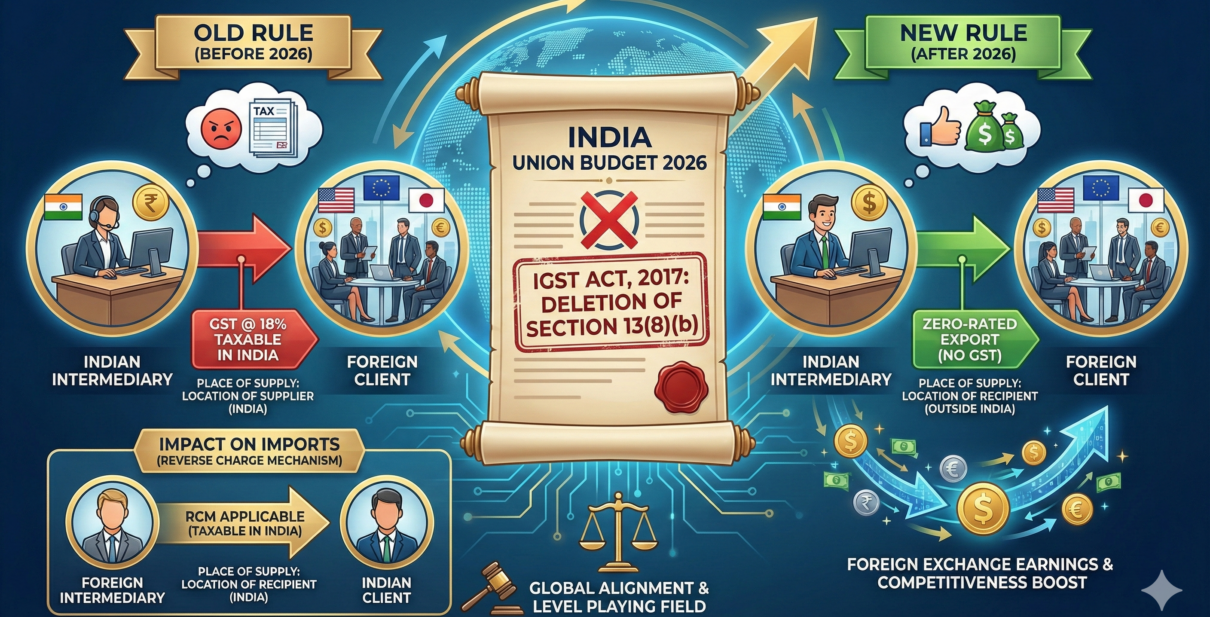
Under the original IGST framework, most services followed the “destination-based” principle—tax was applied where the service was consumed. However, Section 13(8)(b) created a specific exception for intermediaries (agents, brokers, and facilitators). It dictated that the Place of Supply for an intermediary was the location of the supplier.
This meant that if an Indian company provided marketing or brokerage services to a client in the USA, the “Place of Supply” was deemed to be India. Consequently, these transactions did not qualify as “exports” and were hit with an 18% GST, even though the service was consumed abroad and paid for in foreign currency.
The Solution: The Shift to Section 13(2)
With the deletion of this restrictive clause, intermediary services will now fall under the general default rule of Section 13(2). Under this rule, the Place of Supply is the location of the recipient of the service. This simple administrative change has two massive implications for the industry:
1. A Massive Win for Service Exporters
For Indian intermediaries serving foreign markets, this is the “Export of Services” status they have been fighting for.
Zero-Rated Benefit: Since the place of supply is now the foreign recipient’s location, these services qualify as exports.
No Tax Burden: Indian companies will no longer need to charge 18% GST to foreign clients.
Refunds: Businesses can now claim refunds on Input Tax Credits (ITC), making Indian service providers significantly more price-competitive on the global stage.
2. Taxation on Imports (Reverse Charge Mechanism)
On the flip side, the change ensures a level playing field through the Reverse Charge Mechanism (RCM).
Previously, if an Indian business hired a foreign agent, no GST was paid because the “place of supply” was outside India (at the supplier’s location).
Under the new rule, the place of supply is the Indian recipient’s location. Therefore, Indian businesses will now be required to pay GST on these services under RCM.
Why This is a “Historic Shift”
The deletion of Section 13(8)(b) is more than just a technical amendment; it is a strategic policy correction.
Global Alignment: It aligns India with international VAT/GST principles (such as those recommended by the OECD), where taxes are consumed where the service is received.
Reduction in Litigation: The definition of an “intermediary” has triggered endless show-cause notices and legal disputes. By removing the tax distinction, the incentive for the department to aggressively reclassify services as “intermediary” is greatly reduced.
Economic Growth: By removing the “tax on exports,” the government is incentivizing the outsourcing industry, potentially leading to a surge in foreign exchange earnings and job creation in the agency and brokerage sectors.
Conclusion
The Budget 2026 proposal to retire Section 13(8)(b) marks the end of a complicated era in GST history. It signals the government’s commitment to “Ease of Doing Business” and acknowledges the vital role Indian intermediaries play in the global economy. For businesses, this is the moment to review service contracts and supply chains to leverage the benefits of a truly borderless service tax regime.
*** Keywords: Budget 2026, IGST Act, Section 13(8)(b), Intermediary Services, Place of Supply, GST Export, Reverse Charge Mechanism, Indian Taxation, Service Tax India.